Thursday, October 29, 2015

What Is a Credit Score and How Do You Check It?

Good evening students,

I am sure you all heard about the important about having a good credit score. But exactly is a credit score? According to bankrate.com, your credit score is a three-digit number generated by a mathematical algorithm using information in your credit report (What is a credit score?). Basically, it is designed to predict risk. Your credit score is very important because it can, and will, mean the difference between denied or approved for credit. Companies look at your credit score to qualify for an apartment, buy a car, get a mortgage on a house, open a credit card, etc.

There are two types of credit checks. They are hard and soft credit checks. The hard credit check is used when consumers apply for a credit card, auto loan, mortgage or basically any other loan. It slightly lowers your credit score, and it will stay on your credit report for about two years. It is not a good idea to constantly getting a hard credit check because you want a higher score. The soft credit check is when you personally check or a company checks your credit report as a background check. Soft credit checks do not lower your credit score (Lee 2014).

Most companies use FICO to pull a soft or hard credit check. FICO scores range from 300 to 850. Basically, the lower the FICO score, the more at risk you are.

Elements of Your Credit Score


Here is a video explaining how to check your credit score.


Works Cited

Lee, J. (2014, July 24). The Difference Between Hard and Soft Credit Inquiries. Retrieved October 29, 2015
What is a credit score? (2010, April 22). Retrieved October 29, 2015, from http://www.bankrate.com/finance/credit-cards/what-is-a-credit-score.aspx

Tuesday, October 13, 2015

Balancing Your Checkbook

Good evening students,

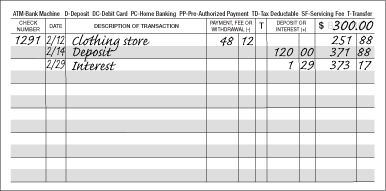
Almost everyone has a checking account. If you bank online it is still important to learn how to balance your checkbook. It is easy and it only takes couple minutes every month. It teaches you good money habits in the long run. Balancing your checkbook means writing down every transaction as it occurs. Make sure to include any fees, such as, ATM fees. You record these transactions in your check register. You will know current bank account balance. This was helpful before online banking. I can already hear you saying,"What is the point of this when I can check my balance instantaneously?" The reason is banks make mistakes. This is a known fact. You want to make sure your register matches your monthly bank statement. If it does not, you can either go to the bank or reconcile it online.


Example of what balancing a checkbook looks like.

Five steps to a balanced account


  1.  Enter all transactions into your checkbook register each day.
  2. Review your account statement as soon as it arrives. Compare the monthly statement to your checkbook register, and place a check mark next to all of the items that match.
  3. Adjust your checkbook register if necessary. 
    1. Add or subtract items on your register that appear on your statement but were overlooked when filling in your register.
  4. If you find errors, double-check everything.
  5. You are done when your register balance matches your bank statement. 
Best of luck,

Zahra

Work Cited 

Balancing and Budgeting — Balancing Your Checkbook. (n.d.). Retrieved October 13, 2015, from http://www.capitalone.com/financial-education/money-basics/balancing-budget/balance-your-checkbook


Friday, September 18, 2015

How to Write a Check


Good Afternoon Students,

Some students were asking me how economics applies to their everyday life. When a person goes online to check their balance for their checking account, writes a check, buys and sells stocks/bonds, file for taxes, makes purchases, buys a car, and etc,. It all relates to economics. A person even performs what is called "cost-benefit analysis" when deciding who they want to marry and if they want kids. "Cost-benefit analysis" simply means the pros are weighed against the cons. That being said, economics is everywhere. Writing a check is a simple concept but not many people of this generation knows how to fill one out. It is an important life skill that everyone needs to know. Below are six simple steps on to write a check with six easy steps. 
An example of a check.

  1. Write the date on the top right hand corner that says date.
  2. Write the name of who you are making the check to on the "pay to" line. This can either be a person or a company. *If it is to an individual, put the first and last name*
  3. Write the amount of the check to the right below the date on the dollar sign line. You need to write the exact about using dollars and cents. 
  4. On the "pay to the order of" line write the monetary amount of the check in actual work form. 
  5. Sign the check on the bottom right corner that is labeled "MP".
  6. Fill out the memo section on the bottom left. This part is optional but beneficial. It is a memo to yourself. It can also be a place where you write your account number. 
**Things to remember**
  • On the bottom on your check there are several numbers. The set furthest to the left is your routing number. The middle set is your account number (to your checking account). The right set of numbers is the check number. 
Hopefully after reading this blog you will be successful with writing your first check.

Best of luck,

Zahra


Work Cited

Checking Account Basics. (n.d.). Retrieved September 18, 2015. 

Why No One Knows How to Write a Check Anymore. (2015, June 15). Retrieved September 18, 2015, from http://money.usnews.com/money/blogs/my-money/2015/06/11/why-no-one-knows-how-to-write-a-check-anymore